
Lower Property Tax Blog
Property Tax
Common Reasons for Property Tax Overassessment
Property Tax Guide
Quick Answer
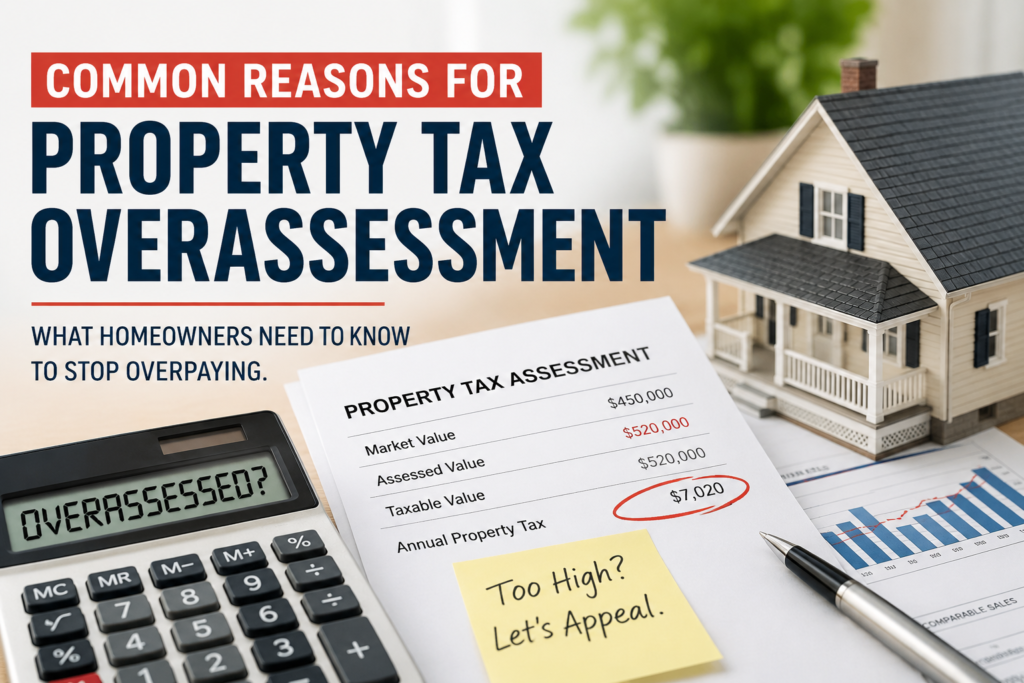
Property tax overassessment happens when a home is valued too high for tax purposes. Common causes include incorrect square footage, outdated property records, missing exemptions, bad comparable sales, ignored condition issues, or an assessed value that does not reflect the real market value of the home.
If your assessment is too high, your tax bill may be higher than it should be. That is why homeowners should review their assessment every year.
What Is Property Tax Overassessment?
Property tax overassessment means the local assessor has assigned a value to your property that may be higher than what is fair, accurate, or supported by the market.
Your property tax bill is usually based on a combination of assessed value, taxable value, exemptions, and local tax rates. If the value portion is too high, you may be paying more than necessary.
Overassessment does not always happen because someone made an obvious mistake. Many assessments are created using mass appraisal systems, neighborhood averages, public records, and prior sales data. Those systems can miss details that make your home different.
1. Incorrect Square Footage
One of the most common reasons for property tax overassessment is incorrect square footage.
If your assessor’s record says your home is larger than it really is, the assessed value may be too high. Even a few hundred extra square feet can affect value, especially in areas with high home prices.
Homeowners should compare the assessor’s property record against reliable information such as a prior appraisal, floor plan, builder record, survey, or their own measurements.
2. Wrong Bedroom or Bathroom Count
Bedrooms and bathrooms can affect how a home is valued. If the public record says your home has more bedrooms or bathrooms than it actually has, the assessor may be comparing your home to properties that are more valuable.
For example, a three-bedroom, two-bath home should usually not be valued the same way as a four-bedroom, three-bath home in similar condition.
3. Finished Basement Listed Incorrectly
Basements are another common source of overassessment.
A home may be incorrectly listed as having a finished basement, full living area, extra bedroom, or additional bathroom. In some cases, the basement may be unfinished, partially finished, outdated, damp, or not comparable to above-grade living space.
If the property record overstates basement finish or usable living area, the assessment may be inflated.
4. Condition Problems the Assessor Does Not See
Assessors often cannot see the full condition of the inside of a home. That matters because two homes that look similar from the street can have very different values.
Condition issues that may support a lower value include:
- Old roof
- Foundation problems
- Water damage
- Outdated kitchen or bathrooms
- Electrical or plumbing problems
- Structural repairs needed
- Deferred maintenance
- Damage from fire, flood, storm, or other events
Photos, contractor estimates, inspection reports, and repair invoices can help show why your home should not be assessed like a fully updated property.
5. Bad Comparable Sales
Comparable sales are one of the most important parts of a property tax appeal. If the assessor uses homes that are not truly comparable, your assessment may be too high.
Bad comparable sales may include homes that are:
- Much larger than yours
- Newer or recently renovated
- In a better location
- On a larger or more valuable lot
- In better condition
- In a different school district or market area
- Sold during a different market period
Good comparable sales should be nearby, recent, and similar in size, age, condition, style, lot size, and features.
Learn more in our guide to how to find comparable sales for a property tax appeal.
6. Missed Homestead or Primary Residence Exemption
Many homeowners overpay because they are not receiving an exemption they may qualify for.
A homestead or primary residence exemption can reduce taxable value or lower the tax burden for a qualifying owner-occupied home. If that exemption is missing, your tax bill may be higher than it should be.
Homeowners should review the exemption section of their tax bill or property record each year.
7. Missed Senior, Veteran, Disability, or Local Exemptions
Property tax relief programs vary by state and county, but many areas offer exemptions, credits, freezes, deferrals, or reductions for qualifying homeowners.
Common property tax relief categories include:
- Senior homeowners
- Disabled homeowners
- Disabled veterans
- Surviving spouses
- Low-income homeowners
- Primary residence owners
- Agricultural or conservation property owners
Missing an exemption can cause a homeowner to overpay even if the assessed value is otherwise correct.
Read more about common property tax exemptions and reductions.
8. Market Value Has Dropped but the Assessment Has Not
Sometimes the local real estate market changes faster than the assessment system.
If home prices decline, sales slow down, mortgage rates rise, or comparable homes sell for less, your assessed value may no longer reflect current market reality.
This can create an overassessment if your property is still being valued based on stronger market conditions from a prior year.
9. The Property Was Recently Purchased
A recent purchase can sometimes trigger a reassessment or change the taxable value of a home. That reassessment may be accurate, but not always.
If the assessor values the home above the purchase price, ignores needed repairs, or uses stronger comparable sales than the market supports, a new homeowner may have a reason to review the assessment.
New homeowners should not assume the first post-purchase assessment is automatically correct.
10. Renovation or Permit Data Was Misread
Permits and renovations can affect property value, but not every project adds the same amount of market value.
An assessor may overvalue a project if the record suggests a larger improvement than what actually occurred. For example, a repair may be treated like an upgrade, or a partial remodel may be valued like a full renovation.
If your assessment increased after a permit, review whether the improvement was accurately described and fairly valued.
11. Your Property Has Negative Location Factors
Location affects value, but not every home in a neighborhood has the same location quality.
Negative location factors may include:
- Busy road traffic
- Railroad tracks
- Power lines
- Commercial or industrial property nearby
- Drainage or flooding issues
- Noise problems
- Irregular lot shape
- Limited privacy
If the assessor compares your home to properties without those issues, your assessment may be too high.
12. The Assessment Is Based on Outdated Data
Some assessments rely on older sales, outdated property characteristics, or neighborhood assumptions that no longer match the current market.
Outdated data can be especially problematic when there has been a shift in local home values, interest rates, buyer demand, or neighborhood conditions.
13. Your Home Is Compared to Updated Homes
A common overassessment problem happens when an older, outdated home is compared to renovated homes.
If nearby sales include homes with new kitchens, modern bathrooms, finished basements, new roofs, updated mechanical systems, or premium landscaping, those homes may not be fair comparisons.
Your home’s condition should be considered when reviewing assessed value.
14. The Lot or Land Value Is Too High
Property tax assessments often include both land value and improvement value.
If the land value is too high, the total assessment may be inflated even if the home value appears reasonable. This can happen with odd-shaped lots, steep lots, wetland areas, easements, access issues, or lots that are not as usable as neighboring properties.
15. Property Classification Is Wrong
Some properties are classified by use, such as residential, agricultural, commercial, vacant, or mixed-use. If the classification is wrong, the tax treatment or assessed value may be wrong.
Homeowners should check whether the property is classified correctly and whether the classification affects exemptions or tax rates.
How to Check If Your Home Is Over-Assessed
To check whether your property may be over-assessed, review these items:
- Assessment notice: What value did the assessor assign?
- Property record: Are the home details correct?
- Comparable sales: Did similar homes sell for less?
- Condition issues: Does your home need repairs or updates?
- Exemptions: Are all qualifying exemptions applied?
- Appeal deadline: How long do you have to act?
What Evidence Helps Prove Overassessment?
Good evidence can make a property tax appeal stronger. Useful documents may include:
- Recent comparable sales
- Assessment notice
- Property record card
- Photos of condition issues
- Repair estimates
- Inspection reports
- Recent appraisal, if available
- Exemption paperwork
- Proof of incorrect square footage or property details
See our guide on what documents you need to appeal property taxes.
How LowerPropertyTax.com Helps
LowerPropertyTax.com helps homeowners review whether their property tax assessment may be too high and prepare a ready-to-file appeal packet.
You enter your address, answer a few questions, and receive guidance designed to help you challenge your assessment.
Click. Print. Mail. One flat fee. No percentage of savings. You keep 100% of your savings.
Think Your Home May Be Over-Assessed?
Start with your address and see whether your property tax assessment deserves a closer review.
FAQ: Common Reasons for Property Tax Overassessment
What does property tax overassessment mean?
Property tax overassessment means the value assigned to your property for tax purposes may be higher than the value supported by market data, property condition, or accurate property records.
What is the most common reason for overassessment?
Common reasons include incorrect property records, bad comparable sales, missed exemptions, outdated assessor data, and condition issues that were not considered.
Can incorrect square footage raise my property taxes?
Yes. If the assessor’s record says your home is larger than it really is, the assessment may be too high, which can increase your tax bill.
Can missed exemptions cause property tax overpayment?
Yes. If you qualify for a homestead, senior, veteran, disability, or local exemption and it is not applied, you may pay more than necessary.
How do comparable sales help prove overassessment?
Comparable sales show what similar nearby homes actually sold for. If similar homes sold for less than your assessed value, they may support a lower assessment.
Can I appeal if my home needs repairs?
Yes, condition issues may support a lower value if the assessment treats your home like a better-maintained or updated property. Photos, estimates, and inspection reports can help.
What should I do if I think my home is over-assessed?
Review your assessment notice, check your property record, gather comparable sales, confirm exemptions, document condition issues, and file before your local appeal deadline.
Related Property Tax Guides

Check your property tax savings
Start with your property address and get a preliminary savings estimate.
Check My Savings